I’ve always been interested in those taking the bold step – people with big ideas who are trying to solve big problems. And there’s nobody bolder than Andrew Song, co-founder of Make Sunsets, a controversial climatetech startup that is launching balloons filled with sulfur dioxide into the stratosphere to cool the earth.
Yes, that’s right.
It’s a fascinating idea, a true moonshot, and an idea that Andrew Song believes provides the stopgap between rising temperatures and a more resilient future.
Andrew and I go in depth on what his company does, the science behind it, the idea of “moonshot thinking,” and the power of just getting started.
If you’d like to learn more, check out Andrew on his LinkedIn and Make Sunsets on their website.
I’m primarily interested in the concept of resilience, whether personal, communal, or societal. What does resilience mean to you?
I think it’s just getting back up after you fall down. That’s pretty much it. Don’t be afraid of failure, because I think that fear actually stops people from being resilient.
Resilience, to me, is really just the ability to bounce back. I learned that at a very early age; my parents instilled it in me. I was a swimmer and started competing when I was eight. I’ve never been the biggest guy in the room, so I had to learn how to lose, a lot, before I figured out how to win.
I was racing guys who were four to six inches taller than me, and in swimming, that matters. But I learned that if you can develop your technique and use your body efficiently, you can still be fast. That’s what really taught me: I don’t have to be the biggest. I don’t have to be the smartest. I just have to work hard and iterate faster.
That’s interesting. In a lot of these conversations, resilience comes up almost like a muscle – you have to work hard at it in order to actually grow in resilience. It sounds like your background in swimming gave you that repetition, that practice in losing before winning.
Do you think those early experiences shaped how you move through life now?
Oh, absolutely. I don’t know how you gain that kind of resiliency or agency without actually doing it. You can read all the books you want about resilience, but until you put it into practice, it’s really hard to overcome that psychological fear of failure.
You and your co-founder have a lot of experience in Silicon Valley and tech. Can you talk about the switch from tech to green technology and whether it feels like a natural fit?
Sure. I think for me, it was always a kind of parallel process. Actually, the first company I ever wanted to start, back in 2010, was sustainability-related.
I grew up in a family with four kids, all athletes, and we ate a lot of food – but we also wasted a lot of it. My poor mom had to cook for four hungry kids all the time. Sometimes we’d eat everything, sometimes we wouldn’t, so she always overcooked just in case.
That experience inspired an idea I had. You’d take a picture of your grocery receipt, use OCR (optical character recognition) to identify what you bought, and then get recipe recommendations to help use up any leftovers. That was my first real concept, during the early App Store days. I just wanted to reduce food waste because about 30% of all food ends up in landfills.
But I quickly learned that most people don’t actually care about saving food! Still, I learned a lot from that experience, and I discovered I had a knack for selling. That eventually led me into Silicon Valley. I grew up here, so I was very familiar with the tech scene and its cycles. It was a natural fit, and I just thought, “I want to try this.”
So when the opportunity to start Make Sunsets came along, it really felt like a coming home moment. I’d spent ten years learning, and this was my chance to put it to use. I wasn’t just going to sell SaaS or hardware, but to take the skills I’d built up and return to the problem I actually cared about from the beginning.
She sounds like a good mom!
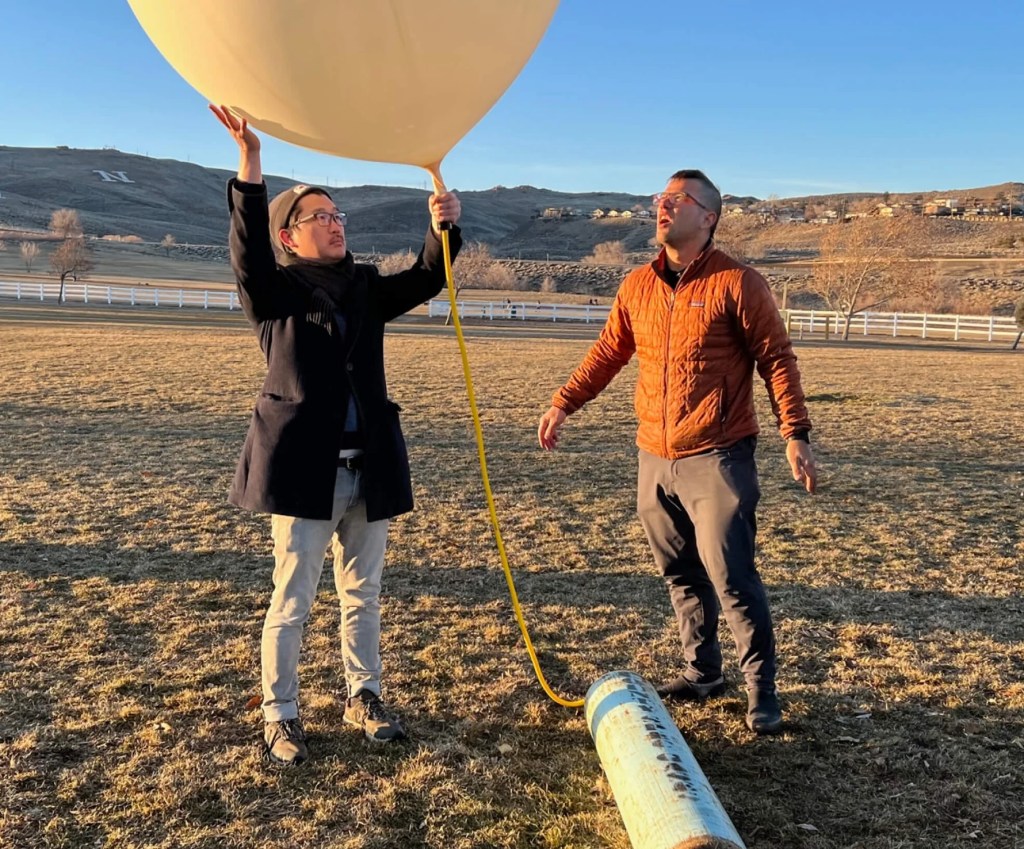
Make Sunsets uses balloons to launch reflective clouds into the stratosphere to combat the greenhouse effect. Can you talk a bit more about what exactly it is that you’re doing?
Make Sunsets is using stratospheric aerosol injection. That’s the technique we’re using to reflect some of the sun’s energy away from Earth. As you probably know, greenhouse gases trap heat. A lot of really smart people are working on removing greenhouse gases so they don’t keep building up and heating the planet. But right now, we’re putting more in than we’re removing.
As you trap more energy, more bad things happen, like higher variance in global weather events, things like that. But what we discovered was that there was this volcanic eruption in 1991 called Mount Pinatubo that injected about 20 million tons of sulfur dioxide into the stratosphere, and it cooled the Earth by 0.5 degrees Celsius.
And more recently, there was the Hunga Tonga eruption in the Pacific (look it up, I’m not making up that name!) that happened in 2022. It injected about 400,000 to 700,000 tons of sulfur dioxide, and that actually cooled the Earth by 0.1 degrees Celsius.
So yeah, at first glance, that sounds like a lot of sulfur dioxide going up into the atmosphere. But actually, we all live in the troposphere. That’s where all living species are and where 99% of weather happens. And Make Sunsets is going one level up, into the stratosphere. That’s where these volcanic eruptions are really effective at reflecting the sun’s energy.
So, to put it in context, a volcano’s 20 million tons sounds like a huge amount, but humans currently emit about 70 million tons of sulfur dioxide every year into the air we breathe. That comes from coal plants, diesel emissions, industrial processes, ships. Basically anything that burns fuel with sulfur in it.
Sulfur dioxide is actually pretty effective. Even in the troposphere, it reflects some sunlight. But if you put it higher, into the stratosphere, it’s like 20 times more effective. That’s because of two things: one, the winds up there are really fast, so it disperses quickly. And two, since there’s not a lot of weather up there, so it doesn’t rain out.
Interesting.
This is a great example of moonshot thinking – an out-of-the-box solution that aims to boldly solve a major challenge.
We’ve talked about the volcanic aspect and the science behind it, but can you talk about how you personally developed this concept? What helped you build the momentum to take action and actually start this project?
The concept of stratospheric aerosol injection has actually been around since the 1970s. There have been over 2,000 academic papers written about it! It’s very well modeled.
You’ll see a lot of papers that focus on the potential downsides, and there have been academic institutions that have tried to move toward actual deployment, but they’ve usually been blocked. Often, it’s by well-intentioned people saying, “Hey, we shouldn’t be doing this.” And to be honest, academics aren’t necessarily the right people to push this forward anyways.
So a lot of the inspiration came from that logjam of really great ideas that just hadn’t been implemented.
The reason we’re pursuing this is because stratospheric aerosol injection hasn’t been well explored at the deployment level. We’re just getting started. We’re still a two-man company, but we’ve already gotten a lot of attention.
I think the reason we’ve gotten so much attention is because it’s such a novel idea. Like you said, it’s a moonshot, and I agree, it’s kind of crazy. Instead of removing something from the atmosphere, like greenhouse gases, we’re actually adding something to it. That’s a foreign concept to most people.
The simplest way to describe what we’re doing is sunscreen for Earth. So all we’re saying is, instead of applying it to the troposphere, apply it to the stratosphere, where it’s more effective.
That’s so interesting.
And the fact that there’s such a long academic tradition behind this is surprising.
I recently read a study on AI in the environmental space, and while there’s a lot of bold innovation happening there, the market doesn’t always value it like other types of AI. A lot of it ends up in academia or NGOs because of the tragedy of the commons, you know, things everyone agrees we should do, like protecting biodiversity or cleaning plastic out of the ocean, but no one wants to pay for.
Can you talk about how you’ve approached this differently as a for-profit company tackling a global environmental issue?
Yeah, people ask us all the time, “Why aren’t you a nonprofit or an NGO?” But we believe the only way this will ever be widely accepted is if it works within a capitalist system and if people vote with their wallets.
The beauty of what we’re doing, compared to other sustainability efforts, is that it’s extremely cheap. We did the math recently, and to offset all manmade global warming since the 1850s, it would cost about $3 per American per year. That’s one cup of coffee.
To give some context, the Smithsonian costs about $3 per American per year. And the Smithsonian is awesome. It educates people and preserves our history. But for the same price, you could have a more livable planet.
Other climate solutions often come with political baggage. You’ve got people saying we need to degrow the economy, stop eating meat, give up trucks. But a lot of Americans don’t want to change their lifestyle. What’s different here is that you don’t have to!
I want capitalism to win. I want people to have access to meat that doesn’t emit so much CO₂ and maybe lab-grown meat will get us there. But right now it’s too expensive. Same with EVs. Telling someone to give up their Ford F-150 for an electric vehicle? It’s a non-starter for a lot of folks. And it doesn’t help when the people pushing these ideas are still living lives full of fossil fuel consumption themselves.
Our solution doesn’t require lifestyle changes. One, because it’s cheap. Two, because it’s deployable pretty much anywhere. We can do this in the ocean or in remote areas. California lets us do it now, which is where we’re from, so that’s where we’re deploying.
I totally agree. Capitalism has to be part of the solution if we want lasting change. But environmental work is a long game, often measured in decades, while startups are typically built around short timelines. How do you reconcile that?
Honestly, I don’t want Make Sunsets to be a 100-year company. I want us to shut down as soon as possible. This is a stopgap solution.
The best analogy I can give you is that we’re Ozempic for the climate. Ozempic doesn’t cure obesity, but it buys time and reduces the worst effects while people try to get healthier. Climate change is the same. The real danger is the heat. CO₂ itself isn’t going to kill us, at least not directly, but the rising temperatures it causes will. Until we scale carbon removal, plant more trees, and shift to sustainable fuels, we need something like this to buy time.
You’ve been getting a lot of media attention. What would you say is your biggest success so far? And on the flip side, your biggest failure or challenge?
That’s a good question. In terms of success, I mean, we’re literally the first company in the world trying to commercialize stratospheric aerosol injection as a service. There’s a startup analogy where you’re building the car while you’re driving it. For us, we’re building the car and the road at the same time.
It’s hard to say we’ve failed yet. I mean, we’re not dead. When we started in October 2022, we thought we’d get shut down immediately. Like, “Wait, you’re copying volcanoes? You’re using sulfur dioxide? Isn’t that acid rain?” But we’re still here.
Now, are we profitable? No. So technically we’re what startups call “default dead” since we’re burning more money than we’re making. But we’re about halfway to default alive. That’s when your revenue outpaces your burn. So we’re making progress.
We’re transparent about this. Every month we post how much money we have in the bank, what we spent, our sales, what we failed at, and what we’re working on. This is all about trying to figure out how to become a profitable company. We’re not there yet, but we’re closer than I expected.
Going back to bold thinking – has anything influenced your appetite for that? Or have you always been that way?
I think it comes down to how I was raised. I’m the middle child. The youngest is the baby, the oldest is the golden child, my sister’s the only girl, and then there’s me. So growing up, I was kind of the wild card.
But really, I’ve always had a safety net. I’m fortunate. My parents came to Silicon Valley in the late ’70s. If they had stayed in South Korea, I probably wouldn’t be doing any of this. A lot of it comes down to luck, and I try not to forget that.
You mentioned that safety net – and in a previous interview, someone told me they think resilience comes from that. Like, having a partner or family who loves you even if you fail. That safety makes risk-taking possible. Sounds like that applies to you.
You’ve talked about a long academic tradition behind this idea. Are there any other climate tech concepts you came across that you think deserve more attention?
Yeah, actually. Space mirrors are pretty cool. It’s another form of solar geoengineering. The problem right now is the launch cost. But as the space market grows and prices drop, I think that’s something we’ll pursue ourselves.
The idea is to put a constellation of mirrors at the Lagrange point, halfway between the Earth and the sun, so you can basically dial down the sunlight. I want to live in a world where we can control the weather the way we control the A/C in our cars. But right now the material science and economics aren’t there yet.
Eventually, though? I think it’ll happen.
10 years ago, 99% of the space industry was government funded. But today, it’s something like only 20%. Private industry makes up the vast majority now. Feels like we’re on the edge of something big.
So what’s next for you and Make Sunsets?
Right now, the next big milestone is doing a large enough deployment that it’s detectable by satellite. We already have people buying what we call “cooling credits.” One credit offsets the warming of one ton of CO₂ for a year. It’s like a carbon credit, but instead of removing CO₂, we apply aerosol.
Eventually, we want to scale enough to trigger satellite detection. These are the same satellites that detect volcanic eruptions. It’s third-party verification, and the data is public. Anyone can ping the satellite and pull the data themselves.
We’re not talking about 20 million tons like Pinatubo. Scientists say 100 to 1,000 tons might be enough for detection. That’s our next big step, and we’ve got about two years of runway to get there.
If you’re curious, read more about the science. And when people bring up concerns, always ask: “How much would it take for that bad thing to happen?” Because people will say, “This could cause acid rain.” But how much sulfur would it take? It’s not 1 ton. It’s not 69 million tons, and we tolerate that amount right now from other sources. That context matters.
What’s the best way for someone to contact you?
You can reach us at info@makesunsets.com, or through our website. We’re also really active on Twitter. Our handle is @makesunsets.
Anything else you want to share?
Just something for your readers. If you have an idea, just do it. People get so hung up on what might go wrong. Start small. We did. Our first balloon had just one gram of sulfur dioxide in it. That’s the weight of a dollar bill. And Time Magazine covered it.
That one gram? It didn’t do anything. It wasn’t dangerous. But we started. And once you start, maybe someone notices. Maybe someone cares. And you go from there.
A lot of people think 100 steps ahead, start thinking early about how could this fail? But you really don’t know until you try. Until you start talking to people. That’s what agency looks like. And look, we thought we’d be shut down in the first six months. We’re still here. I’m talking to you two years later.
That’s all I can say. Just start.
Want to learn more? Go more in depth here:

 Mick Hammock
Leave a comment