Tag: permaculture

  • Planting an Urban Forest: An Interview with Tree San Diego

    Planting an Urban Forest: An Interview with Tree San Diego

    When you think of city management and design, do trees come to mind?

    The good folks at Tree San Diego think so, and think that you should too!

    Tree San Diego is an urban forestry nonprofit who works to increase the quality and density of San Diego’s urban forest — and they have some thoughts about the importance of urban trees and how they contribute to a resilient community.

    Trees, and by extension, the “urban canopy” (the layer of leaves, branches, and stems of trees that cover the ground in an urban environment when viewed from above), have an important role in city design. They make cities cooler, quieter, more desirable, more efficient, and safer — and therefore, more resilient. San Diego has recently announced a plan for a dramatic increase in our urban canopy in hopes of reaping some of these benefits — and I turned to the experts at Tree San Diego to find out more.

    In this interview, you’ll learn all about why we need to have trees in our urban spaces, not just on our trails, as well as the number of benefits that urban trees and urban forests provide! You’ll also learn how Tree San Diego works to select their species, how they account for disease and pests, and the role of trees in urban planning.

    If you’d like to learn more about Tree San Diego and their mission, you can check them out on their website. I’d also like to give a special thanks to Elekra Fike-Data, Chris Klier, Chuck Morgan, and Kurt Peacock from Tree San Diego for their help and expertise with this interview.

    What does the concept of resilience mean to you and Tree San Diego? And how are urban trees part of a resilient community?

    Resilience is the ability to recover from problems or conditions that are not ideal. We at Tree SD are choosing tough, low to moderate water-use tree species to better prepare for the warming, drier climate we will face in the coming years.

    San Diego hopes to increase their urban canopy to 35% of the city by 2035. Can you talk about the benefits of having such a large, developed urban canopy, and what that would mean to the average resident?

    Hitting the 35% cover target will improve the quality of life for everyone in San Diego! Some of the immediate benefits include lowering temperatures, reducing pollution and storm water runoff, blocking ultraviolet light more effectively. Residents will want to be outdoors more, more active in recreational activity and lowering heating and cooling bills, which burns less fossil fuels.
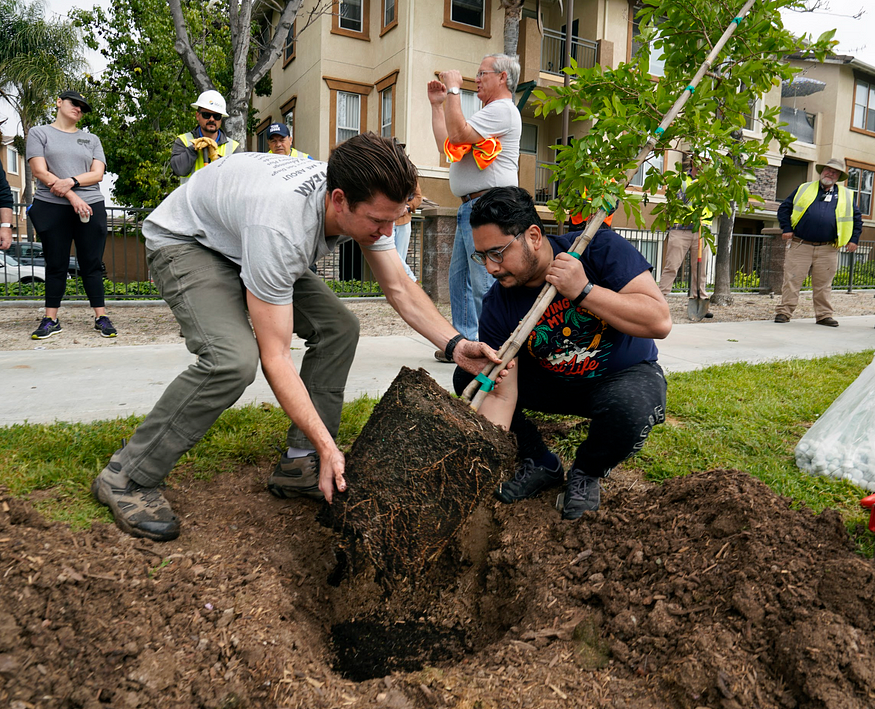
    Community Planting Day! (PC: Tree San Diego)

    Many folks associate San Diego (and, more broadly, Southern California), with palm trees — which are actually a non-native species! Can you talk about your process of choosing which trees (and where) to plant?

    Palms may be iconic, but they do not provide the ecological benefits that broadleaf or evergreen trees provide. They require annual maintenance which makes them more expensive to maintain than other trees.

    We base our tree selections on the soil volume available and the utility situation, such as overhead wires, to prolong the useful life of trees. Microclimates can also affect what we select — we need to keep in mind dimensions like sun vs. shade, soil grade, and proximity of buildings and other fixed infrastructure to the site, ultimately striving to maximize the size of any tree in a given site. The bigger the tree can grow, the more benefits it provides!

    San Diego is known for being an extremely biodiverse area, and there are a number of extremely unique environments in the county — from desert, to mountains, to ocean, just to name a few. Can you talk about the importance of wilding the urban environment? Have you received support from the outdoors community for your initiative?

    Wilding and rewilding our urban environments are important since it improves health, provides areas for recreation and relaxation, improves biodiversity, and expands our wildlands and ecosystem restoration. Here in San Diego, we see examples of this in our local estuaries from Carlsbad, to Carmel Valley, and Imperial Beach. Balboa Park is another example, which has both wilderness areas and more formal, landscaped areas. The various cities within San Diego are focusing now on more “plantscaping,” and adding trees to our urban areas. In fact, in small open areas around the city, local officials are now looking to create pocket parks!
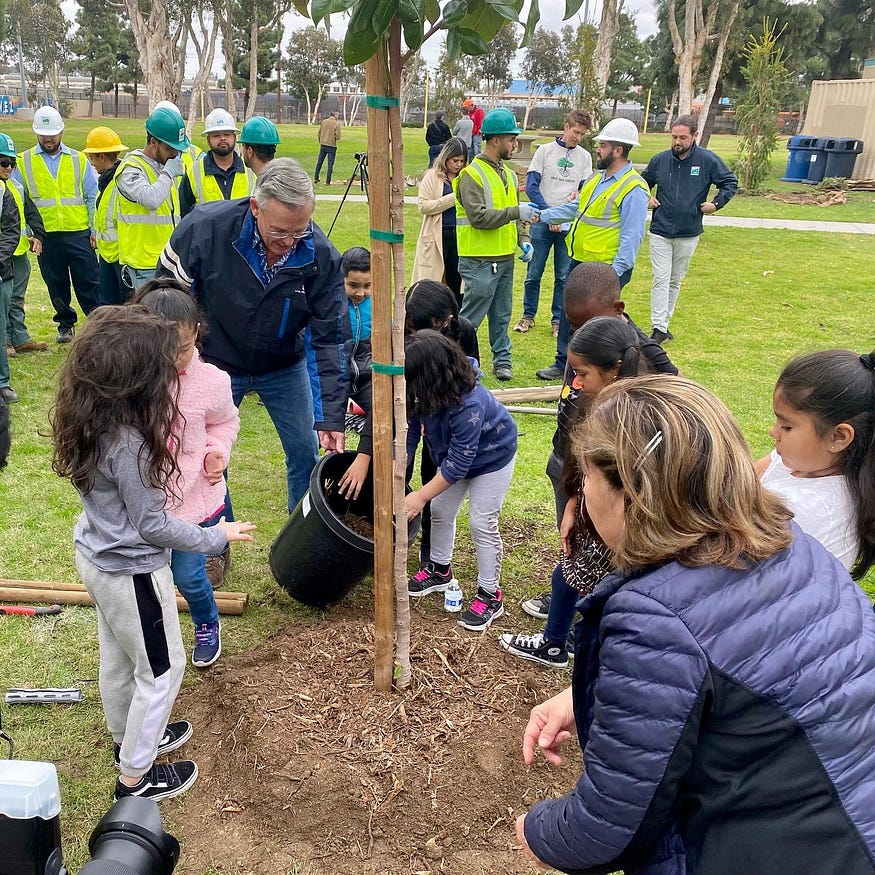
    Planting an urban tree in Caesar Chavez park! (Photo: Tree San Diego Facebook)

    Water use is always a major concern for any SoCal resident. How does planting more trees affect a city’s water and usage?

    Planting trees uses a lot of water, especially during the establishment period. However, I believe the benefits gained with planting more trees far outweigh the additional water needed. For example, a tree cover will save 11,000 tons of soil annually in a medium sized city. A tree-shaded, air conditioned home can improve its efficiency by 10% and saves up to 34% of annual costs. Trees planted in the right place for a home can reduce heating costs up to 25%. Trees are natural air conditioners, cooling the air through transpiration (how plants evaporate water). Trees improve real estate value by 1% of sale price. Trees reduce and mask noise with white noise. One acre of trees will provide enough oxygen each day for 18 people to breath, while, at the same time, absorbing pollutants and filtering particulates. Trees planted in parking lots can reduce the ambient temperature by 3% and car interior by 30%. 100 mature trees intercept 210,000 gallons of water per year, allowing cities to spend less money on storm water control and keeping water pollution out of our estuaries, rivers and ocean. The list of benefits goes on and on!

    On the campus of UC San Diego, there are 27,000 trees. These trees sequester 7,560 tons of CO2 annually, and remove 6,210 pounds of pollutants from the air. A study conducted by the human-environment laboratory of the University of Illinois at Urbana Champaign concluded that a tree-filled community recorded a lower incidence of violence and vandalism than a community that was less forested. Additionally, trees can lower stress and help provide speedy health recovery. The benefits are monumental!

    Meanwhile, the city of San Diego is working to be water independent by recycling water. By the end of 2035, nearly 50% of San Diego water will be provided by taking waste water and purifying it to high-quality drinking water, and will actually cleaner and safer than our present drinking water. You can learn more about this initiative here. So there are a lot of things at play!

    You also run a project that diverts end-of-life urban trees away from the wood-chipper/landfill and towards other products. Can you talk more about the success of this program, and the difference between what happens to a tree in this program vs a normal urban tree?

    The Treejuvenation project was a small pilot that really started when we realized how many exotic trees are grown in the temparate San Diego climate. Once these trees reach the end of their life, they can be collected for their viable wood. The urban forester now thinks about what trees should be planted on a longer scale — not just thinking of planting the tree for now, but thinking about the end of life, and planting trees that can eventually turn into desirable lumber. As another benefit, the tree care industry strives to ensure that urban trees grow as straight as possible which makes them ideal for harvesting for lumber as opposed to being cut up and dumped in the landfill or chopped into firewood!

    What do you see as the future of the tree in urban planning and design? Have you seen an uptick in support from governments and planners in including more environmental elements such as trees in new developments?

    Trees are only increasing in importance for urban planning as we move forward into a changing climate. Many new developments have trees and environmental elements as a focal point, rather than an afterthought. This is a trend that we expect to see throughout urban planning, especially with support and funding opportunities from government and other stakeholders.

    How are you helping build resilience into Tree San Diego? What is a major obstacle that you have overcome?

    Tree San Diego is building organizational resilience through diversifying funding sources, strengthening partnerships, and growing to meet growing needs. While not unique to our organization, limitations related to COVID-19 were a major challenge. Tree San Diego prides itself on connecting and working with the community, but during the height of the pandemic we were unable to work face-to-face with folks. Instead, we adapted our programs, conducting our training virtually and delivering trees to be planted at individuals’ homes rather than community planting events.
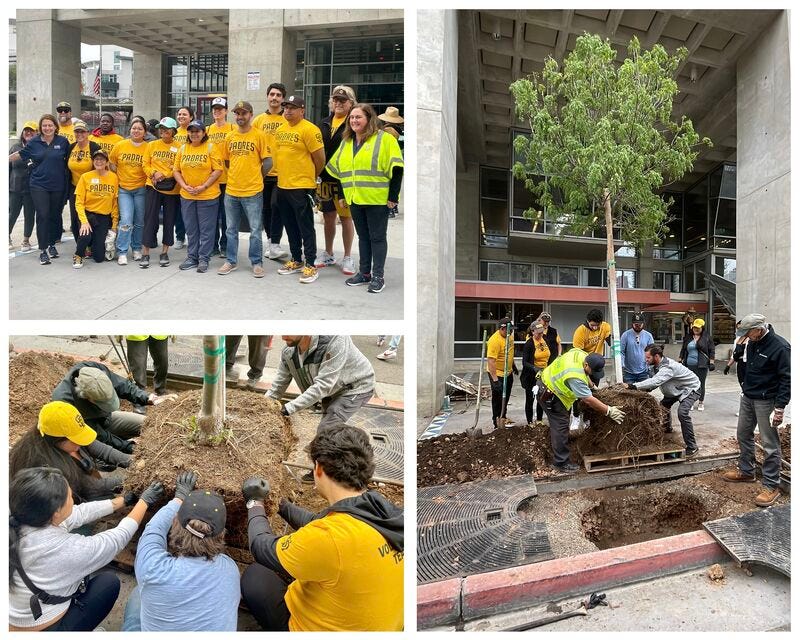
    (Photo: Tree San Diego Facebook)

    Can you talk about your biggest success so far as part of Tree San Diego? What helped you achieve it?

    Tree San Diego was recently awarded a federal IRA Urban Forestry Grant to continue planting trees, training candidates through our Treejectory workforce development program, and building a regional urban forestry management plan. This $2 million grant award will allow us to bring the benefits of trees to thousands of people while empowering communities in priority populations zones to grow and care for a newly planted urban forest.

    I know you partner with a number of groups around San Diego. Do you have plans to partner with urban forestry groups outside of San Diego?

    Yes, we will work alongside the US Forest Service, CAL FIRE, and other NGOs in California to achieve our goals of building a greener future.

    What is next for Tree San Diego?

    Tree San Diego will embark on a path to expand our impact, influence, and statewide partnership. As our team plans to celebrate the organization’s 10th anniversary in 2024, we are currently building models to broaden our shared urban forest and plan for sustainable urban forestry management throughout the region.

    What are the best ways for people to learn more about, or get involved with, Tree San Diego?

    Get involved and stay in contact with our team by joining the TSD Leaflet Newsletter, signing up for Tree Steward training, becoming a Terrific Tree Member, and donating to the cause.

    Want to learn more? Go more in depth here:

    Tree San Diego Website

    Urban Tree Canopy Overview

    City of San Diego’s Forest Management Programs
    Get a Free Tree from the City of San Diego!

    City of San Diego’s Tree Canopy Plan

  • Harvesting Resilience in San Diego County: An Interview with the San Diego County Farm Bureau

    Harvesting Resilience in San Diego County: An Interview with the San Diego County Farm Bureau

    Recently, I got the opportunity to speak with the San Diego County Farm Bureau — a non-profit organization tasked with fostering San Diego agriculture through education, public relations, and public policy advocacy. As someone who’s primarily lived in the urban parts of San Diego, I was shocked to learn that San Diego is ranked #1 in the United States in part time farmers, nursery crops, and avocados — and is home to more small farmers (less than 10 acres) than any other county!

    In this interview, you’ll learn how farmers, large and small, contribute to San Diego’s local economy, communities, and food production. You’ll learn about the problems farmers are facing and how they’re striving to overcome them, and how you can support the farmers, large and small, in our community.

    If you’d like to learn more and connect with the San Diego County Farm Bureau, you can connect with them on their website.

    I’m chiefly interested in the concepts of resilience — personal, communal, and societal. Farms are such an integral part of a community’s health and economic development. What does the concept of resilience mean to you and the San Diego Farm Bureau?

    Farmers are the most resilient people when it comes to doing their job, which is providing the community with fresh produce, flora, and fauna. In order to do this, they need to have the persistence to overcome and face the many challenges of farming. Some of these main issues they face include water pricing, pests, labor, and the overburdening of regulations at the local, state, and national levels.

    What are some ways that the San Diego Farm Bureau works to build resilience through the San Diego region and the San Diego farming community? What are some ways that farms contribute to resilience within a community?

    Farms contribute to all civilized societies because they produce the essentials of life. SDCFB helps famers with regulatory compliance, public education, political advocacy and technical training.

    How would you describe the unique character and strengths of the San Diego farming community? What makes it different from other agricultural regions in California and the United States? Can you talk about how San Diego’s small farmers contribute to the local community and food systems?

    Our farming community is vastly different than any other region in California or even in the US — we have a lot of growers who do more with less land. The average acreage size in San Diego County is less than 10 acres, and we have more “small farmers” than any other county! San Diego’s Mediterranean-like climate makes it an ideal place to grow agricultural crops and livestock products. More than 3 million people live in San Diego County, and around 5,000 farmers call it home and use the land to make their living. The direct economic output from agricultural production totaled $1.7 billion in 2021.

    The high cost of water and land make farming here expensive, so San Diego farms have specialized in integrating agricultural activity and urban living by growing crops that optimize limited acres. San Diego far surpasses its fellow top-producing counties in terms of average dollar value per acre with an agricultural production more valuable than other urbanized areas of California, such as San Francisco, Orange County, and Los Angeles combined!

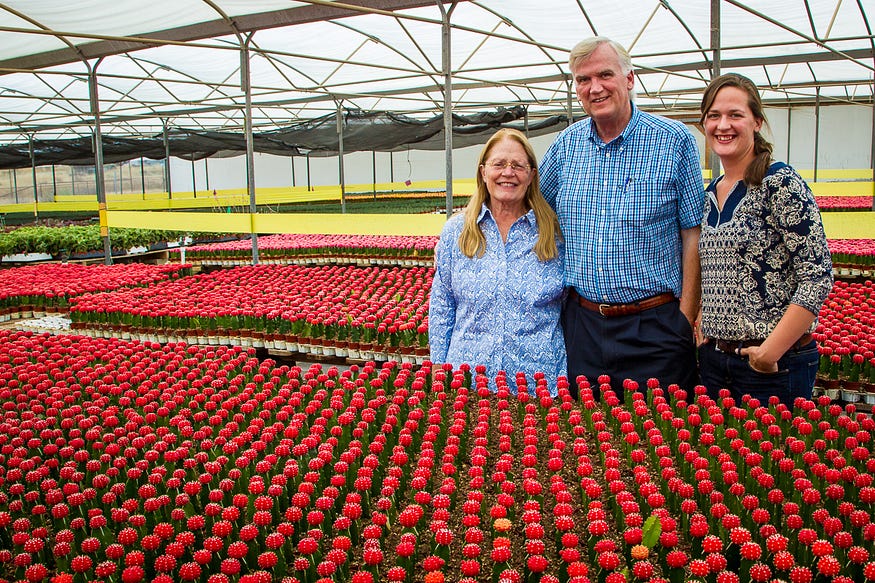
    San Diego has more small farmers than any other county! (Photo Credit: SDCFB)

    Can you talk about the integration between urban living and agricultural activity in San Diego County? Are there any programs in place to continue growing this integration? How does this contribute to community resilience, particularly with food systems?

    The integration between urban living and agricultural activity in San Diego County is simply due to the availability of farmable land. In many ways it can be more of a hinderance, especially when the neighboring residents do not understand certain farming practices. For others, it might provide an educational aspect. We always hope for the latter for our farmers!

    For the farmers who grow and have a farm stand, it is a great way to know where your food comes from and be able to see the fields right next to you — or maybe you see the fields on your way to work every morning, and consumers can develop that relationship with their local farmer. Another interesting wrinkle is that many growers in the county grow nursery and cut-flower wholesale products, so that face-to-face interaction can sometimes be tough.

    Other than that face-to-face interaction, there are many other opportunities to provide education to the public, especially through the education system. There is a program called San Diego Ag in the Classroom that is run with the support of Farm Bureau that provides resources to teachers wishing to add agriculture programming to their curriculum. It seems that people are starting to be a little more knowledgeable of where their food comes from, and want to connect with local farmers. We also host a few events that are geared towards both public and legislative outreach.

    What are some of the challenges facing San Diego’s agricultural industry currently? What are the opportunities?

    There are always the staple issues: water (both availability and cost), invasive pests, labor (it’s increasingly difficult to find labor), and increasing regulation.

    However, there are also definitely opportunities! For example, people are becoming more aware of local farming and its importance. Some look to support their local farmers, which is great! There is also a large movement in Ag Tech (agricultural technology) and there will soon be more opportunities for people to become involved in agriculture without necessarily having to be a farmer. This would also create additional ways for farmers to utilize new ag-tech tools.

    Certain industrial farming practices, such as large-scale monoculture farming, have come under fire recently for what critics say prizes efficiency and profits at the expense of food quality and human, animal, and environmental health. How can farms balance economic viability and growth and food production with environmental concerns?

    As we established earlier, San Diego County farming is small in acreage size yet there are so many crops that can be grown in the climate — there are over 200 crops grown in our region! So “industrial farming practices” are not necessarily something that our farmers participate in, simply because our region doesn’t support that type of farming.

    However, I think it is important to point out that most farming operations nationwide understand that without a good product, you can’t make a profit. Farmers are often perceived as using too many pesticides, yet all the farmers I know are extremely conscious of their usage because they don’t want to be wasteful, and pesticide overuse will affect your bottom line. Similarly, a rancher won’t put their animals through harmful processes, since that isn’t compatible with the goal of producing a product that people will purchase.

    The question of balancing economic viability, growth, and food production with environmental concerns is something that farmers face every day, and I’m afraid there’s not a simple answer to that.

    It appears that sustainable, “alternative” farm methods, such as the concept of permaculture, have been gaining traction in the media. What are some examples of sustainable and regenerative farming practices that are being used by San Diego farmers? Have you seen an increase in these practices?

    The words “sustainable” and “regenerative” have definitely created a buzz. However, these are not new practices — they have been around for centuries! Farmers in our region plant cover crops and utilize mulch to rebuild soil health. We have cattle operations that utilize regenerative grazing practices. Similar to what was mentioned above, no farmer wants to harm their land, which is their livelihood and their legacy. These regenerative practices are important to them and will continue to be.

    Occasionally, there are new studies that come out, or new farming practices that come to light, that are beneficial for the environment and for the crops. For example, there were many farmers who shifted to high density avocado farming — the farmers gain more product with less space, and irrigation is easier since the plants are closer. The trees actually become healthier and grow more efficient canopies and root systems.

    It’s also interesting to note that our avocado growers and cut flower producers utilize space that is often otherwise deemed unusable for other purposes, since their crops are typically on steep, rocky hillsides.

    What do you see as the future of farming and food production?

    The future of farming and food production can sometimes look difficult for producers in California due to increased regulations and legislative rulings that affect the way people farm. It has gotten increasingly difficult to be a farmer in today’s climate. We don’t see a lot of farmers in San Diego who use farming as their main source of income, they work multiple jobs in order to make it feasible. However, as mentioned, it seems that the public are becoming more conscious of the scene and are more interested in supporting local.

    When in doubt, try to support your local farmers! (Photo Credit: SDCFB)

    Water use is always a hot button topic in Southern California. How does water use factor into agricultural practices in San Diego? What do you see as the future of water use and resource conservation when it comes to farming and food supply?

    Water in San Diego County is very expensive, and the cost causes real economic hardship for our farmers in North County. We expect the cycles of drought and water abundance to be more extreme in the coming years, and conservation alone is not going to solve the water problems farmers face. Public policy should include funding for water storage and infrastructure so that rainfall can be captured, and water storage can be maximized.

    Interestingly, conservation regulations are driving the cost of water even higher, which in turn causes more economic hardship, more farm closures, and subsequently reduced consumption and higher prices in a vicious cycle.

    What are some ways that others can build resilience in their own life, especially with regards to food security and food systems? What advice would you give to others exploring the idea of growing their own food for the first time?

    Farming is a lot harder than people think — and I bet a lot of people’s house plants could help illustrate this point!

    There are a lot of local garden centers that are willing to help point interested parties in the right direction, and there is also the San Diego Master Gardeners Association. They have great information on caring for gardens. Luckily, there are a ton of resources out there!

    How does supporting local farms (small, part-time, and full-time) contribute to building resilience in the local food system? What are some ways that consumers can support these farmers?

    Our local farmers contribute $1.7 billion economically to San Diego County. The San Diego County Crop report details the importance of our local food system and economy. Checking out local farmers markets and CSA programs (community supported agriculture), buying direct, farm stands, and agritourism operations are all great ways to be more connected to your food system.

    Buying local produce is a great way to support local farmers, keep money in your community, and ensure you’re consuming a high quality product. (Photo Credit: SDCFB)

    How are you working to communicate the value of San Diego agriculture and educate the general public on the importance of San Diego farms? What are some ways that the local, non-farming community can get involved in your efforts?

    We publish farming news via our magazine, newspaper, email, social media, and website, and proactively seek out media opportunities and speaking engagements to share local agricultural news and successes with our community. We plan events such as “Graze at the Fields” and work with the San Diego Fair to spread the good agricultural word. We host meetings that bring stakeholders together and demonstrate the value of agriculture and the value of working together for the common good. Finally, our membership committee is currently working on a membership level that will be more geared towards public involvement and provide resources to be involved in the local farming scene.

    What are the best ways for people to learn more about the San Diego Farm Bureau, your events, the farms that you support, and the local farming scene?

    We encourage people to visit our website to learn more about what we do and the events we host. We also have tabs that list the farmers markets in the county. We support all farmers within the county. Farm Bureau also teamed up with the UC Cooperative Extension, and you can find some great information on agritourism at San Diego Agritourism Storymap.

    Is there anything that you’d like to talk about that I didn’t ask?

    Farmers are no longer a significant part of the population, but are very significant to the overall economy and the health and welfare of any advanced society. It is vitally important for the non-farming public to understand the issues and challenges of farmers and support a healthy and growing farming foundation for their community.

    Want to learn more? Go more in depth here:

    San Diego Farm Bureau Website

    Thank you to San Diego Farm Bureau County Manager, Taylor Reese, for her help with this interview!

  • An Introduction to Exploring Resilience: Three Spheres for Personal, Communal, and Societal Growth

    An Introduction to Exploring Resilience: Three Spheres for Personal, Communal, and Societal Growth

    My whole life, I’ve always been extremely curious.

    This has led me to hurtle headlong towards learning about numerous pursuits (or as my wife calls them, “rabbit holes”) on all kinds of ridiculous topics (sorry about holding you hostage while I pontificated on the Rime of the Ancient Mariner, honey!) because, to me, the main overarching hobby of mine is simply learning something new.

    The past few years, I began to notice that many of my hobbies and rabbit holes all had one overarching theme in common — you could file them all under the umbrella of resilience. I realized that all of my disparate hobbies and interests like Brazilian Jiu Jitsu, permaculture and aquaculture, urban design, backpacking, small business, the circular economy, fitness, and many more, could all be shoehorned under one (or more!) of three different spheres of building resilience — personal resilience, communal resilience, and societal resilience. Over the life of this blog, I hope to explore each of these spheres in turn and highlight examples from my own life, community, and areas of interest that highlight resilience — and teach others how to build resilience in themselves and those around them.

    First, let’s get some definitions down. What do I mean by resilience? Resilience is not just the ability of an individual, community, and society to adapt and thrive in the face of challenges, but about their ability to lessen or avoid the negative consequences and impacts of challenges through strength and a coherent strategic vision to plan for any issues.

    Perhaps this definition is impacted by the nearness of the Covid pandemic — a total shutdown of society that showcased an incredible lack of societal resilience from top to bottom and highlighted just how susceptible many of our social structures we take for granted really are when confronted by an outside force. However, while society on a grand scale languished, many people and local community organizations showed remarkable resilience— leading me to believe that there are different spheres of resilience that should be examined.

    The first sphere is PERSONAL.

    Personal resilience refers to the ability of individuals to perceive, withstand, and overcome obstacles. It encompasses a wide range of factors, including physical, mental, emotional, social, and spiritual wellbeing. I hope to explore the many ways to build personal resilience, by developing skills and habits such as fitness, connection with nature, exploring decision making frameworks, the science of curiosity, and more.

    The second sphere is COMMUNAL.

    Communal resilience refers to the ability of groups of people to be organized and structured in such a way that they lessen the impact of adversity, strengthen communal bonds, and thrive in the face of challenges. Topics might include strengthening families and neighborhoods, building strong bonds within the larger community, highlighting local businesses and institutions that are important to the future (and past!) of a community, fostering a sense of belonging and connection with the nearby natural environment, strong urban design, promoting local food systems, and more.

    The third sphere is SOCIETAL.

    Societal resilience involves adaptability and strength on a large scale when faced with global problems. These challenges can include things such as climate change and resource depletion, or even inflation, monetary policy, and other far reaching, future facing problems. For my purposes, it involves building strong and sustainable economic systems, promoting sustainable agriculture, and developing innovative solutions to environmental problems. I hope to showcase new technologies, large companies, interesting books, and thought leaders who look ahead, solving tough problems and making humanity more resilient as a whole.

    This blog is intended to be more experimental and philosophical about the topic of resilience than a manifesto or call to arms. Its main intention is to meander slowly along, exploring many different facets of the three main pillars of resilience — personal, communal, and societal. I hope to introduce you to new concepts, inspiring people, and interesting thoughts that can fall under the resilience umbrella, and I hope that I’m introduced to some new ideas along the way too. I also hope that this is the last blog post I write in the first person!

    If you have a company, person, book, or hobby that exemplifies resilience, please let me know. I’d love to examine it in greater detail.

    Looking forward to exploring the topic of resilience with you all.