Recently, I caught up with my friend James Kaull, a world-caliber fencer making a push for the 2024 Olympic games. James has been competing in the sport since he was just 8 years old, and has gone far — fencing on an NCAA championship team at the University of Notre Dame and even competing in the World Championships.
Fencing is an extremely mentally taxing sport, so I wanted to learn more about James’ mental approach as he trains for and faces the highest competition in the world. You’ll learn what he’s thinking before he competes, the importance of patience and trust in oneself, his breathing techniques for high-pressure situations, the importance of finding and developing a physical identity, and much more. Quite simply, it was a great interview and a great peek into the mindset of a world class athlete.
If you’d like to learn more and connect with James, you can find him here on his Instagram.
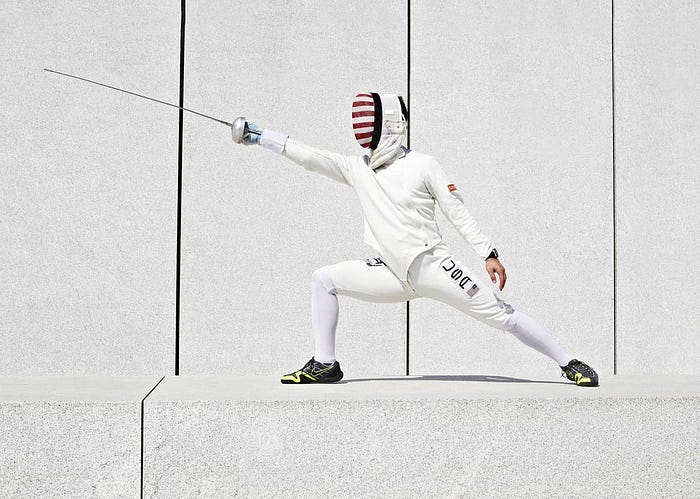
I’m chiefly interested in the concepts of resilience — personal, communal, and societal. What does the concept of resilience mean to you?
I’ve actually thought about this one before, and, if I had to give it a definition, I think I’ve landed on being patient while being uncomfortable. Patience in chaos. Whether you’re physically uncomfortable, mentally uncomfortable, dealing with ambiguity…resilience is being patient, and keeping and finding calm.
You were a Division 1 fencer on a Notre Dame team that won a NCAA championship. More recently, you’ve competed in the World Championships. Can you give a little background as to how you started fencing, your successes, and where you are in your journey currently?
I began fencing when I was just 8 years old in Washington D.C. I found fencing to be pretty cool, quick, and exciting. It was violent in a way that I enjoyed, and I still find it so exciting. In fact, recently I taught fencing in some public schools in New York for six months, and during a tournament, I heard a kid say that he couldn’t sleep that night because of the adrenaline rush he experienced. That’s the kind of feeling that drew me to fencing when I was younger.
In my youth, I was a dominant fencer, holding the number one spot in the Y10s, Y12s, 14s, 16s, and Under 20 category. I believe that I had some talent for the sport, but I also had good coaches and parents who gave me the space to pursue it without interfering. This was important because I saw many talented kids whose parents weren’t good fencing or sports parents, which took the fire out of them. In college, I had success winning the NCAA championships my sophomore year and being a Top 20 Under 20 fencer in the world.
After college, I had the opportunity to train at the New York Athletic Club with a coach I admired, who was already 80 years old when he accepted me as a student — and he’s been my coach for 10 years now. Honestly, his life and resilience make my own seem like a grain of sand. Still, since joining NYAC, I’ve had some successes, including being top three in the country for a couple of years, finishing the 2020 season at 47th in the world, winning two big national tournaments with 300 fencers, and beating some super high-caliber fencers who have won Olympic medals.
Currently, I’m training for the 2024 Olympic Games, although I’m not as big of a front runner I once was. I know I have more talent around me now, but I’m pursuing it with intuition and the benefit of understanding when to peak. It’s been a different kind of resilience this time around, seeing others do well and learning to be patient with that. It’s been an art form in and of itself.
Can you elaborate a bit more on what you mean by it’s a different type of resilience?
It’s a tricky situation. I missed out on the last Olympics despite fencing my best a year and a half before the trials. It’s difficult to control when you perform at your peak, especially since you never know what triggers it. And when you do perform well, not only are you doing better than usual, but it’s new to everyone else as well. However, this element of surprise doesn’t last forever. Once people become familiar with your fencing style, it becomes harder to maintain that level of success.
I remember someone on the circuit telling me, “It’s over when the other competitors start saying hi to you,” and it’s true. When people know who you are and what you’re capable of, it becomes more challenging. And on this go-round, I’ve been focusing on other things. That’s not to say that I’ve been losing on purpose but I’ve been working on building up my fundamental movements to improve my overall skills. While others are showing off their full tool set, I’m focused on building a solid foundation that will translate into my fencing when it’s really time to perform.
It’s tough to see others surpass you and you’re not getting the same recognition or attention. It’s a mental exercise to trust in your abilities and believe that your hard work will pay off, even when there’s little evidence to support it. It’s crucial to be comfortable with the possibility that your perspective and ideas might be entirely wrong. But, I’m confident in the deliberate work I’ve done and the order in which I’ve done it. I hope that what I’m doing will lead me to success, but I also acknowledge the very real possibility that it might not.
It sounds like you not only have to trust in yourself, but in your skillset and your preparation — as well as really being comfortable with failure.
Yeah, it’s not about being comfortable. It’s more than just being comfortable. You have to feel the exact same no matter the outcome. My mind, my sense of gratitude, my sense of competition can’t change, no matter the outcome. My approach does not change based on the outcome. Tactics change, and matches change, but not the approach.
How have you built that approach?
You have to really take a look at yourself and determine what you’re not good at. You need to identify your weaknesses and work on them deliberately. It’s not easy — you might have to start from scratch and completely rebuild what you’ve learned poorly. And it’s going to take a long time to get back to even just being bad again. But the progress you make there will help other areas. Surprisingly, the areas I seem to struggle the most are often the ones that people think are static and unchangeable. So, it’s crucial to focus on what I was lacking in the last competition and work on it relentlessly. I’ve taken this approach, and I’m hoping that by the time I need to really compete well I’ve done enough to have some successful matches.
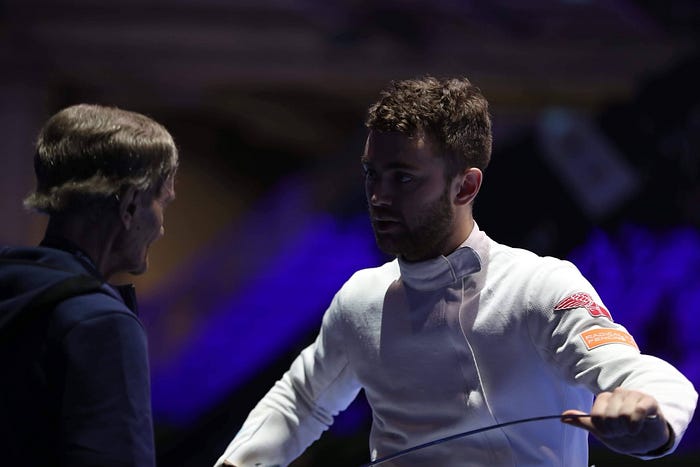
Fencing is one of the most mentally taxing of all sports, often being compared to playing chess. Can you talk about the mental side of fencing? What does that entail? What are some ways that you train mentally to stay focused for large tournaments and tough competition?
Fencing is extremely mentally taxing, not just in terms of preparation but also while competing. What makes it so engaging is that from the moment you start fencing, it’s like an active crisis that you’re managing. Your opponent is constantly trying to deceive you while you’re trying to deceive them.
You’re constantly showing intentions or movements that represent other moves and actions, and doing it with things like distance, either distorting it or making it really close or being very far away. To hit your opponent, you have to trick them, and that creates a pretty intense environment. Moreover, the fact that it’s an individual sport means that if you lose, you have no teammate or group effort to share the blame or bail you out.
To mentally train for fencing, I have a meditation routine that centers on breathing through challenging situations. It helps keep me breathing at a regular rate because the breath can determine my mood and thoughts. If I can use my breath to steer my thoughts into a good place or at least a non-negative one, it’s a real advantage not just in fencing but also in everything else, like arguments or tense conversations.
Finding this calm through meditation — does this help you keep your mental approach the same for each competition?
Sometimes it’s not just about calming yourself down, because let’s face it, sometimes you just can’t. It’s not helpful to try and force yourself into a state of calmness and then feel like a failure if you don’t achieve it. The important thing is to be able to handle the intensity of the moment, whether you feel calm or not. That’s the real challenge, and it’s something you have to be prepared for.
It helps you accept where you are and how you’re doing.
Yeah, there are days when you feel calm while fencing and everything just clicks, and you perform brilliantly. It feels effortless and you’re in the zone. But then there are days where things just don’t go your way from the start. Maybe you’re running late, your equipment malfunctions, or the referee makes a bad call. It’s stressful, and you have to grind through it all. You may not fence well, and you may even lose, but you still have to keep going and push through to the end. It’s all part of the experience, and you have to be able to handle both the good and the bad days.
So this meditation also helps you manages during high-pressure situations?
I always try to focus on my breath during a match, as I think it’s really important to keep myself from moving faster than I need to. Biometrically, people tend to want to go fast in fencing, but when someone moves quickly, it’s usually a big change in speed that can be picked up by the eye, even if it doesn’t necessarily gain them anything. That’s why there’s value in being able to be slow and deliberate. As the old sports saying goes, “slow is smooth and smooth is fast,” and that’s especially true for some of the older fencers on the circuit who may not be faster than the younger guys, but are able to control their body in a way that makes it hard to see them start to hit you. So, staying calm and focused on my breath helps me create more of those deliberate movements and has been really beneficial for me.
I guess this comes back to my original definition of resilience as “patience while being uncomfortable,” or “patience in chaos.” It’s also probably why the kid I coached that I talked about earlier couldn’t sleep after a fencing tournament was up all night. He probably hadn’t learned this yet.
What are some of the biggest obstacles, mental, physical, or otherwise, that you’ve faced in your fencing career, and how have you overcome them? What have been your biggest successes?
I always try to overcome mental obstacles in fencing, but it’s not always easy. For instance, during my junior year of college, my coach couldn’t get his visa, so I had to run the program myself. It was frustrating not to feel supported, but I just had to get through it. I didn’t win, so I wouldn’t really say I overcame it. It was only a few years later that I realized I did a good job. I think the key is to accept things either way and stay balanced and stable. I’ve had some clutch moments, but I’ve also messed up at times, so I don’t want to say that one thing is my key to success.
Something major that I often think about is dropping things that don’t serve you. This can be hard because you become attached to them. I saw a big jump in fencing results when I started lifting weights, but then I ultimately had to let go of heavy weightlifting because it wasn’t agreeing with my body. I had to experiment with different things and find what worked for me. It’s okay to let go of something that was working before if it’s no longer serving you. For example, I was losing flexibility in my hips and experiencing back injuries, so I started doing more yoga. In retrospect, it would have been better if I didn’t lift heavy weights in the first place. It takes time to find what works best for you, and it’s important not to judge yourself along the way.
Can you walk me through your pre-competition routine? Other than the meditation, how do you mentally prepare for a match?
The meditation is a daily practice, but life happens and it’s okay to miss a day. It’s important to not beat yourself up if you miss a day. Just pick up where you left off the next day.
Pre-competition routines vary from person to person. For me, I like to start slow and do yoga to stretch out and relax. Others prefer to get their heart rate up with jumping rope and sprints. Mentally preparing for a match can be challenging because negative self-talk can creep in, which honestly hinders me. I really don’t view myself as resilient in this way, honestly. I don’t really want to engage with that dialogue. Some people use it and prove the haters wrong, and that’s amazing to me. I don’t think I’m built that way, but that’s fine. The goal is to not attach to those thoughts, but to let them pass.
My breathing technique that I use to calm myself down in moments of panic, which involves breathing in for six seconds, holding for two, breathing out for eight seconds, and holding for two again. This prolongs the periods of not thinking, which can be helpful. It’s important to focus on what you can control in a fencing match, such as your actions or staying loose, rather than solely focusing on winning or losing.
How do you manage to balance your work, personal life, and training as a high-level fencer, and what strategies have you used to stay resilient and focused on your goals despite the demands on your time and energy?
I think the challenging aspect of balancing multiple areas of life is that it requires a lot of hard work and effort to do it right. Even when you’re working diligently, it can feel like nothing is going well. Sometimes it seems like you have to pick one or the other — you can either have a killer personal life, or you can be killing it professionally, or you can be killing your fencing. It’s up to you to choose where you will see success.
It’s important to recognize that time and energy are limited resources, and sometimes you may need to prioritize rest over pushing through a tough training session or trying to accomplish everything on your to-do list. It’s okay to not always achieve everything you want in a day or to feel guilty about not managing your time perfectly. Trust your body’s signals and adjust your priorities accordingly. By doing so, you’ll be able to make progress in the areas that matter most to you over a longer period of time — your body and mind will tell you what is most important to you. Listen to it.
It seems to come back again to making peace with where you are. Seems like a lot of people try to have it all, and at a high level. Lots of people want to succeed everywhere.
My coach made me realize that no matter how well we do, we will always strive for self-improvement. Even after achieving victories, the desire for more doesn’t go away. This applies to careers as well. It’s natural to want recognition and financial compensation for the time put in. However, it’s important to balance this desire with humility.
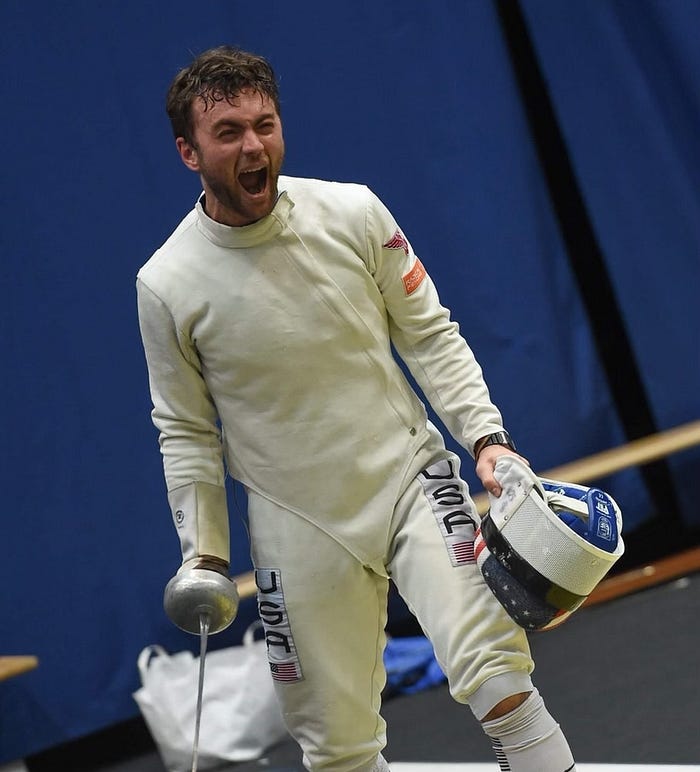
What lessons has fencing taught you that you’ve been able to carry with you to other facets of your life?
I would say it’s taught me patience above all else. Anything worth doing takes patience, but it’s not always easy to remain patient. We humans are wired for instant gratification, and fencing has always been a challenging exercise in patience. But through the frustration, I’ve gained wisdom that I wouldn’t have otherwise. Patience isn’t something that comes naturally to me, but I’m learning to cultivate it, and it’s been invaluable. So, in short, I would say that fencing has taught me the importance of patience.
Which again, I guess, comes back to resilience. Patience in uncomfortable situations — whether fencing or in life.
What advice would you give to others who are struggling with the mental side of their sport, work, or school? How can others take what you’ve learned to build resilience into their own lives?
It’s crucial to be forgiving, really. It’s easy to fall into the trap of beating yourself up, but it doesn’t do anything for your mental toughness. Constantly criticizing your shortcomings doesn’t leave much room for confidence to grow. If you’re struggling in your sport, it’s important to remember that you’ve had some successes along the way. You must have done something right to get as far as you have. Even if the glass isn’t even half full, only a third or a fourth full, there’s still some water in there, and you can always add more.
Sharing what I’ve learned with others to help them in their own lives is something I find valuable. We talked about patience and resilience being a big one, but I also believe in the importance of sports. It’s not just about pro-athletes and glamorous lifestyles. It’s a whole process of learning, both about yourself and your body. It’s a shame when people don’t seem to understand that and fail to appreciate the thing they’re living in.
So, finding and developing a physical identity is very important, and familiarizing yourself with your body. Can you elaborate on that?
The brain is truly an incredible thing. If you’re someone who excels academically but lacks athleticism, that’s great, but it’s important to note that the brain is also meant to interact with the body. There’s a whole other side of intelligence that you can gain from being physically active. I have a friend who is arguably the smartest person I know. He went to Brown, is a software developer, and has created and sold two companies. He’s also a Google developer. Despite his intellect, he didn’t have much physical prowess. He didn’t know how to generate force with his body or group muscles together, which would have made something like, for example, pitching a baseball, impossible for him.
However, he discovered rock climbing, and it completely changed his outlook on physical activity. For the first time in his life, he learned how to map finger strength to his hands, back muscles, everything. He found a physical identity in rock climbing that engaged both his mind and body in a way that was familiar, yet new. As an analytical problem solver, he found that rock climbing was like solving puzzles, and it lit up his brain in a way that was both fulfilling and challenging.
Now, he’s powerlifting and taking the systematic approach of powerlifting to the next level. It’s been a remarkable transformation to witness. He’s gone from someone who couldn’t do much physically to someone who’s doing clean and jerks with big weights.
Sports can teach us a lot about resilience, and my friend’s example is a perfect illustration of that. Regardless of where you start, there’s always room for growth and improvement.
What is next for James Kaull, fencing, work, and otherwise?
Next year, I’m determined to give fencing my all. It has the potential to be a life-changing and beautiful experience, and I’m optimistic about the opportunities that lie ahead. Even if things don’t go as planned, I know I’ll learn valuable lessons along the way. My focus is on improving the areas where I’m weakest and implementing new strategies, and I feel confident in my training regimen.
Balancing work and personal pursuits is challenging, especially when it comes to pivoting in a new industry. I currently work in banking compliance which is stable, challenging, and pays well. However, I’ve always been interested in consumer tech and exploring how people interact with their devices. Perhaps a time will come when I can explore both interests.
Fencing is something that will always be a part of me, and I’m grateful for the opportunities and lessons it’s provided. My coach has taught me valuable lessons that extend beyond fencing, and I’m grateful for the skills he’s instilled in me. I’m reminded of Rush Cohle’s quote in True Detective that goes something like, “We can really only become good at one or two things in our life.” I’m content knowing that fencing is one of mine.
What is the best way for someone to contact you if they’d like to learn more?
Probably the best way is to just hit me up on my Instagram, @james.kaull.
Is there anything that you’d like to talk about or highlight before we go?
I’m in a bit of a routine right now. Work and practice take up most of my time. My girlfriend is a principal at an inner city elementary school and deals with a wide range of competencies in both teachers and parents. It’s really opened my eyes to how fortunate I am to have had great parents, coaches, and teachers. So, to those reading, take a moment to thank those who have made a positive impact on your life — because not everyone is fortunate enough to have that.

 Mick Hammock
Leave a comment